“All hail the PC master race!” If you’ve heard this line–especially if you’re a brand new Playstation 4 owner–it’s likely raised your ire and piqued your curiosity about the actual differences in graphics, speed, and more between your PS4 and a gaming PC. Even with a brief glance at the two camps, the price is an immediately distinguishing factor. There must be some reason that a gaming PC will run hundreds, if not thousands of dollars more than any home console. Price is a good jumping off point for this entire analysis, and from there we can look into all of the curious factors that cause this price and power disparity.
You’re right to be curious, too. Recent advances in graphics capability and hardware costs have resulted in a slightly narrower gap between home consoles and ever-upgradeable gaming PCs. However, the answer to this question is neither quick nor simple, and so we’ll take a look at some of the considerations you’ll need to keep in mind when you’re comparing the two camps. All the way from price to specifications, Appamatix has your bases covered.
Before we get into the nitty gritty, let’s actually break down the three categories that we have to compare if we’re making comparisons between gaming PCs and the Playstation 4. That’s right; not two, but three. If we want this to be a well-rounded analysis, we need to cover ever corner.
- Desktop Gaming PCs
- Laptop Gaming PCs
- Playstation 4 Console
Five years ago, we might not have been obligated to include gaming laptops in an examination like this, but in those few years, the gaming laptop market has exploded. Advances in graphics technology and thermal engineering have allowed manufacturers to pack ever more powerful hardware into a thin laptop chassis. This has allowed gaming laptops to grow into a category of their own, and while the price tags attached to these machines may seem scary, their ability to liberate gamers from the living room and the desk often justifies the cost. Just this year, Razer’s Stealth-brand gaming laptop and “Core” graphics card peripheral took home all kinds of accolades from the Las Vegas Consumer Electronics Show.
When people tout the “PC master race,” however, what they’re often talking about is the raw power that you can cram into a desktop computer’s roomy tower. We’ll examine what constitutes that power in our detailed analysis, but suffice it to say, desktop gaming machines can justify every cent of their cost by cross-examining the parts included in them. Anyone who has ever upgraded components of a desktop computer or built one from the ground up can testify to this.

One final note before we dive into the deep end. There is only one version of the Playstation 4 console, with one set of technical specifications available to consumers (for now; more on this at the end of our guide!) However, when you begin looking at gaming PCs, you’ll notice that the field of available options all but explodes. Laptops ranging from $999 to $2000 dollars, and desktop computers well within that same range of price, from dozens of different manufacturers.
While you might think that this will make a comparison possible, we’ll try to level the playing field by picking a mid range gaming PC and laptop to compare with the PS4.
Sony Playstation 4
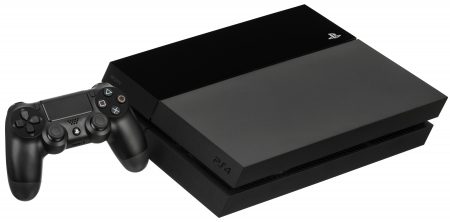
First, let’s get our technical specifications out of the way. We’ll have them as a constant reference for the rest of the guide.
- CPU: x84-64 AMD “Jaguar”, 8 core running at 1.6 GHz
- Memory: 8 GB GDDR5
- Hard disk drive: 500 GB HDD (standard)
- GPU: AMD Radeon GCN, 800MHz
There are other specs we could include on the list to make it longer, but they’re almost inconsequential in compared to the significance of the above. Now, let’s break these down a little bit further.
Many consumers looking at a multicore CPU and simply think, “The more cores the better, right?” While this isn’t necessarily true as a rule, it’s almost constantly true for gamers. While the GHz measurement of the CPU will give you an idea of its overall power, the number of CPU cores available for running tasks speaks to the hardware’s multitasking capability. The PS4 is a media powerhouse; now only does it need to run new games at acceptable speeds, it also needs to be able to flip back to the main menu with a single button press, run a whole host of media-centric apps, and also make use of the new “Share” feature that allows for easy uploading of screenshots and videos.
While the CPU handles processing power, the GPU (graphics processing unit) handles the actual heft of asset rendering, making it possible to display games with gorgeous graphics that move at an acceptable framerate. In general, the speed and memory of the GPU determine the quality of graphics that you can display. This is coupled with the PS4’s onboard memory. 8 GB of GDDR5 is going to ensure that during all of this multitasking and heavy gaming, your console never runs out of available memory while performing its several tasks at once.
Finally, we get to the standard 500 GB HDD (hard disk drive). There are two common types of storage drive available on the market–hard disk drives, and solid state drives. Hard disk drives are less expensive but contain moving parts that make them slower at loading data. Solid state drives are comparatively much more expensive but are also lightning quick in comparison. The storage drive is the single upgradeable part of the PS4, but keeping that in mind, we’ll consider that a freshly purchased PS4 is only going to include that 500 GB HDD.
As of May 10th, 2016, the average retail price for a Playstation 4 is $350.
Desktop Gaming PC

In order to try and keep things fair, we’ll look at a lower-end gaming rig from the popular, Dell-owned Alienware brand. In order to demonstrate fairness, we’ll get the price tag right out in the open, first: this gaming PC is about $1199. It also has slightly newer internal hardware than the Playstation 4, and while this may seem unfair on the surface, it’s actually more than a fair comparison.
The reason? This PC has depreciated slightly in value as well, just like the Playstation 4 has since release. We’ll examine this after we get the specs out of the way.
- CPU: Intel Core i7 “Skylake”; running at 4.0 GHz
- Memory: 8 GB DDR4
- Hard disk drive: 1 TB (1000 GB)
- GPU: Nvidia 970, 4 GB DDR5
We’ll begin the comparison at the top and work our way down. Right away, we can see that the Alienware gaming PC has a vastly more powerful processor. While the Playstation 4 boasts a CPU that was custom designed for its own performance, it’s a simple fact that the desktop PC is just going to carry more muscle in the CPU department. This means faster processing and stronger multitasking.
You’ll notice that the memory allotment is actually very similar to both machines, but the desktop computer will usually have an edge here, as well. Whereas the PlayStation 4’s memory is soldered onto its inaccessible motherboard, more RAM can easily be added to a desktop computer. In this case, the Alienware gaming PC is only using 8 GB of the potential 16 GB that the motherboard can host. This particular desktop PC doesn’t post a solid-state drive, either, even though it does have double the available space. (Do consider that the addition of an SSD comparable in size could easily add several hundred dollars to the price tag.)
Finally, we arrive at the GPU, and this is another area where desktop PCs are going to clobber the Playstation 4. There are a few things to take into consideration other than sheer power, however. Think about the size of your average desktop computer tower, and then compare it to the relative size of a PS4. The desktop computer is going to be much larger in form factor, no matter which manufacturer you’re looking at. For graphics output, this is a big deal, and the reason for that is heat. GPUs generate immense amounts of electrical heat when they’re under heavy load, and unless that heat is dispersed efficiently (usually through fans or liquid cooling), it can cause irreparable damage to computer hardware, eventually frying it outright.
The desktop computer is going to be more powerful, sure. But for its size, the PS4 packs one hell of a punch.
Laptop Gaming PC

Here’s where the water can get muddied even further, but we’ll do our best to keep the playing field fair. In order to keep a strong perspective in our comparison, we’ll be using another Alienware computer as an example from the laptop gaming PC category. This particular Alienware gaming laptop is available at about $1649, a significant leap in price from the desktop PC and especially the PS4.
- CPU: Intel Core i7 “Skylake” mobile; running at 3.5 GHz
- Memory: 16 GB DDR4
- Hard disk drive: 1 TB HDD (1000 GB)
- GPU: Nvidia 970M, 3 GB DDR5
Our comparisons with the desktop gaming PC can be made fairly quickly, which in turn allows for a more accurate comparison with the PlayStation 4’s specs. While the CPUs are definitely from the same “Skylake” generation of Intel processors, the mobile version runs slightly slower than its desktop counterpart. You’ll notice that this is a recurring trend with a great deal of hardware that’s built for laptop’s; it’s certainly close to what a desktop is capable of, but will always be more costly, and will always lose some amount of power when it’s built for a much slimmer system.
The available memory, however, is booming. Like the desktop computer, you can upgrade the available RAM from 16 GB to 32 GB. This particular type of upgradeability is lost on the PS4.
While the hard disk drive also is much the same as what’s available with the desktop computer, that GPU requires a second glance. You’ll notice that there’s an “M” after the release designation of “970,” which indicates that it’s a “mobile” version of the graphics chipset. Much the same as the CPU, the mobile version of any popular GPU is going to be designed specifically with laptop computers in mind. This means that it will be much smaller, and consequently less powerful (but still strong enough to handle most games that you throw at it.)
Conclusion
In conclusion, the actual power and speed hierarchy looks something like this.
- Desktop gaming PC
- Playstation 4
- Laptop gaming PC
There’s an immense amount of wiggle-room in this comparison, especially because the PlayStation 4 is the only entry that’s going to remain static since it’s only available in one configuration from a single manufacturer: Sony.
However, the fact that it can perform at a constantly high rate of performance under the heavy demands of current generation video games means that your PS4 is often going to be a stronger gaming machine than many laptop gaming PCs.
Optimization Benefits
Here’s where things tend to get a little bit simpler for most consumers. When you buy a game for your PlayStation 4, you know that it’s going to run it without any problem. If you weren’t curious about the performance power of your console compared to gaming PCs, you might not even know the technical specifications of your PS4. This convenience can be attributed to optimization, and it’s much easier to accomplish for a home console than it is for PCs.
This is because the PlayStation has static specifications that developers know they can build their games and software for. These specifications won’t change, and so when a developer codes and builds a game to run to those specifications, they can know that it’s going to run on every PlayStation 4 on the market. The same can never be said for gaming PCs, and whether you’re a laptop or desktop owner, you’re going to be constantly cross-referencing your PC’s specs against the requirements of specific games.
In essence, the optimization process prefers the home console. It has for years, and unless something truly drastic shakes up the way that people buy games to play on their PS4s, Xbox Ones, or Nintendo systems, it’s going to continue.
Here’s the skinny, to summarize it nicely: in terms of sheer power, the desktop gaming PC is going to cream all competition, but you’re definitely going to have to pay for that power. Your gaming laptop is going to release you from the bonds of your desk, but it’s going to cost you more. Your PlayStation 4 is always going to play PlayStation 4 games, and it’s always going to do it exceptionally well. To boot, shopping for a PS4 is easy. Gaming PCs, less so.
Bonus round incoming! Rumors are on the horizon about a new, upgraded “PlayStation 4.5” that will be released sometime during the third or fourth quarter of 2016. It will feature upgraded hardware on all fronts, resulting in a better experience for all of your favorite PS4 games. With PlayStation VR hot for its coming release, do you think that we’ll see both new products announced at the same time? I sure do.
We hope that this guide has hoped to clear out that once-muddy water that existed between the PS4 and its PC competition in terms of speed, graphics, and the other issues that beg for your consideration. If we’ve missed anything, or if you have more questions, raise your voice in our comments section!